
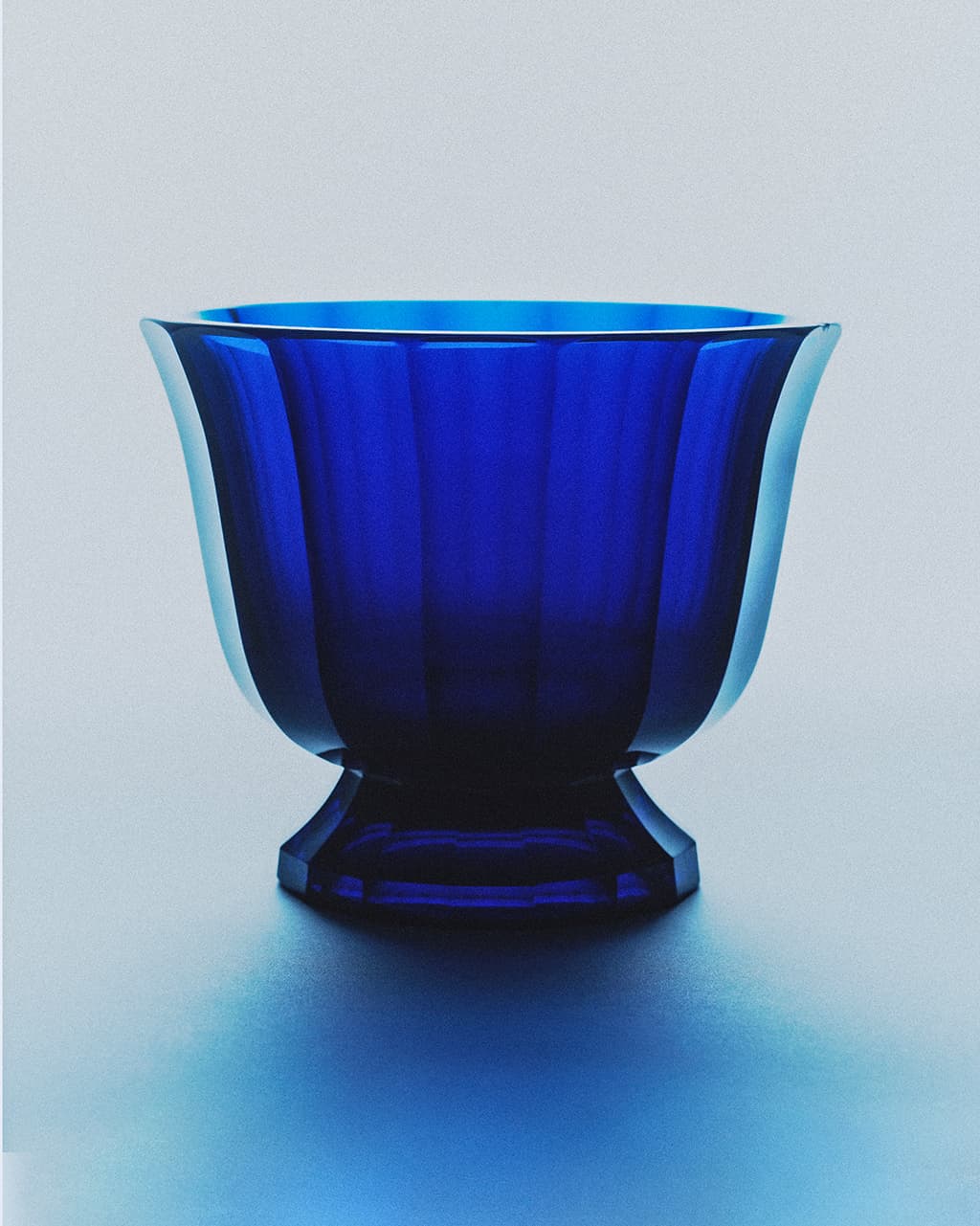

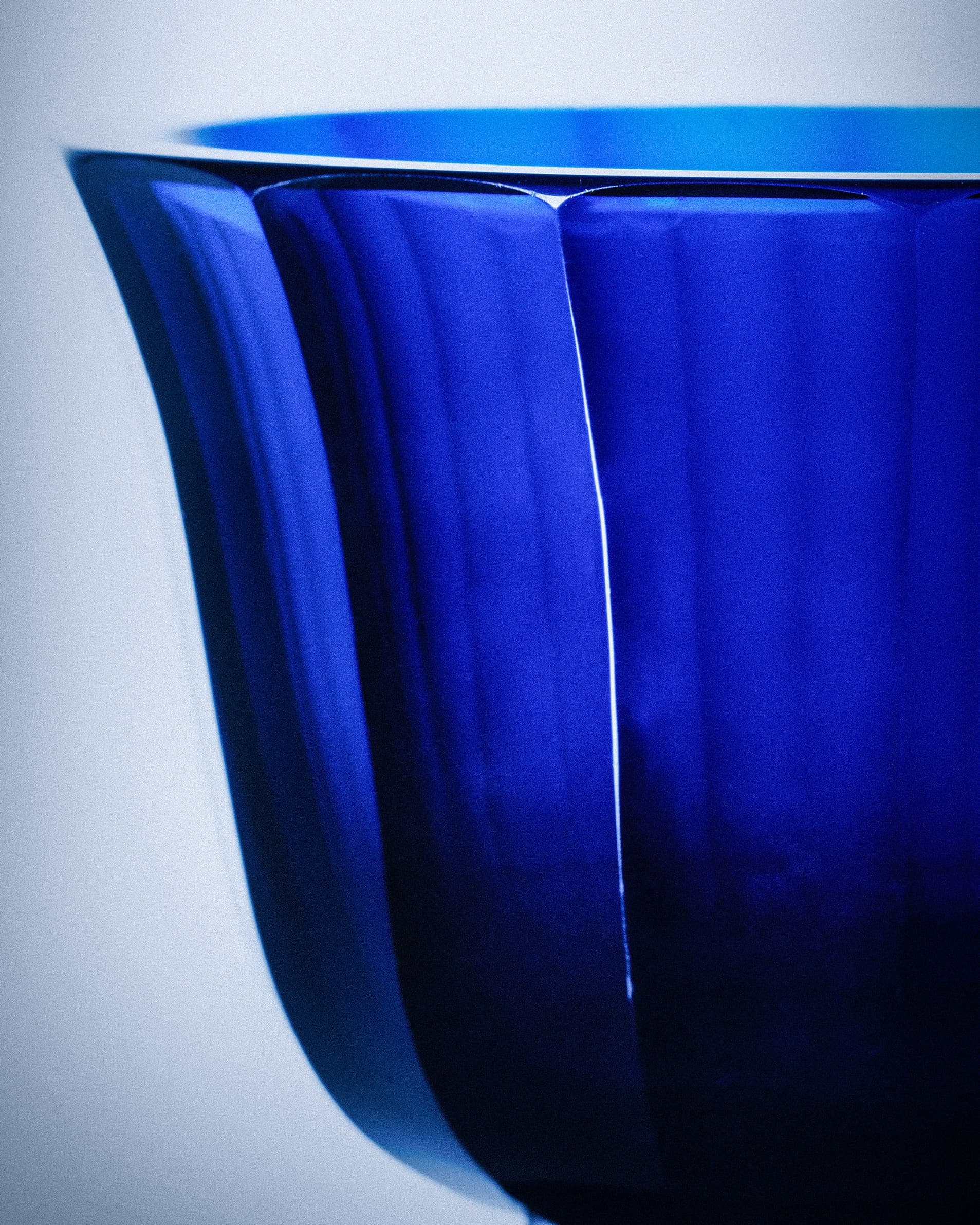
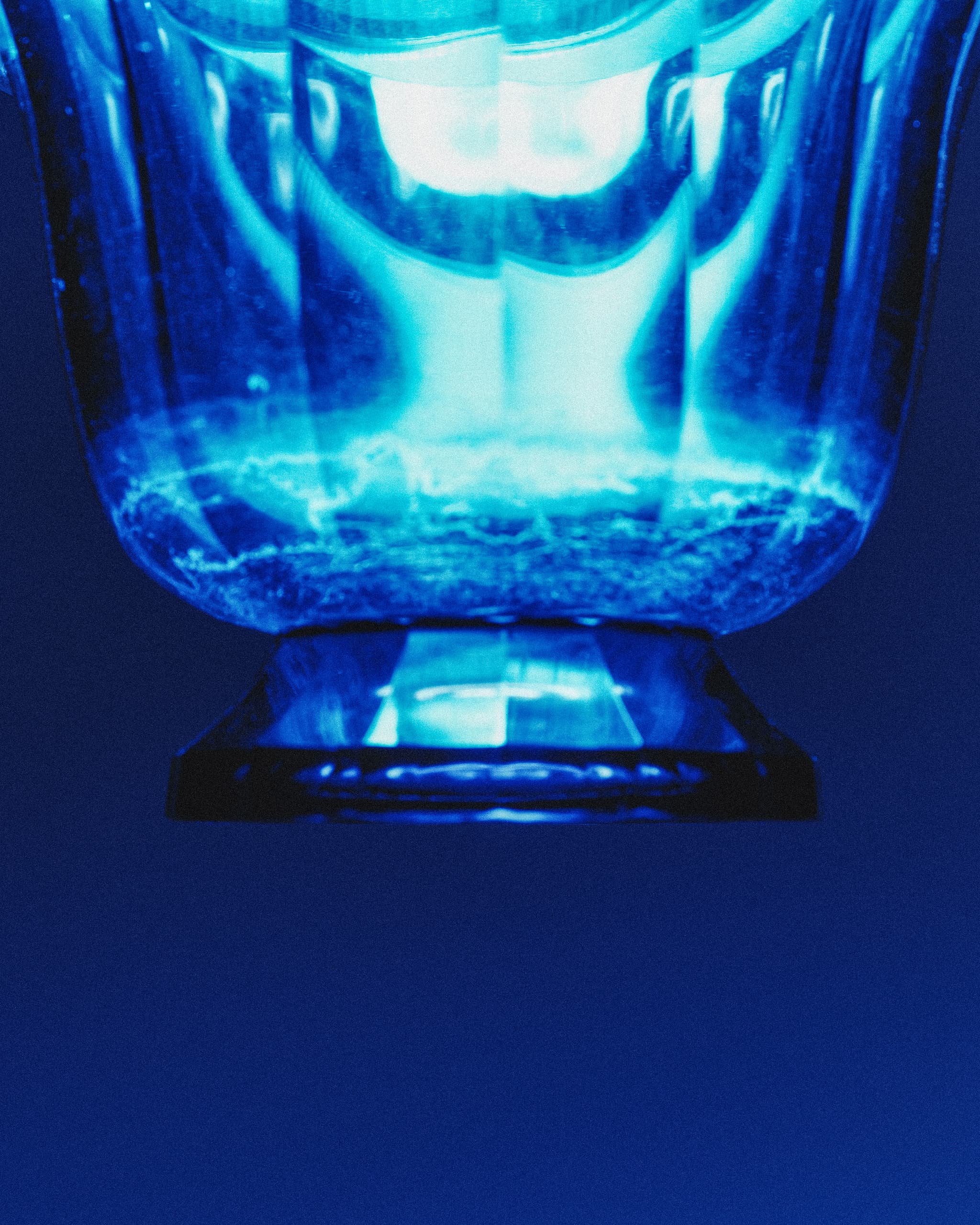
■ FOOTED BOWL IN COBALT CUT GLASS, attributed to Josef Hoffmann (Pirnitz, Moravia, 1870 - Vienna, 1956), the execution attributed to Ludwig Moser & Söhne, Karlsbad, circa 1920s, of the type issued through the Wiener Werkstätte sales channel, the tulip-form body in body-tinted cobalt hand-blown and subsequently cut with vertical flat panels - the Schälschliff or peel-cut technique - descending the walls in separately articulated fields, raised on a short faceted stem and stepped polygonal foot, the whole in the disciplined geometric vocabulary Hoffmann developed for the Moser glassworks over the course of the 1910s and 1920s and catalogued in the 1928 Wiener Werkstätte sales programme. The underside bearing a scratched "WW" cipher; documented Moser-executed Hoffmann pieces issued through the Wiener Werkstätte are more typically encountered with a struck or etched factory WW stamp (see Compare). The present hand-scratched mark is therefore not treated as evidence of Wiener Werkstätte issue, and the piece is offered as attributed to Hoffmann and the Moser glassworks on stylistic grounds.
Fair condition consistent with age and use: chips to the rim, the largest approximately 9 mm, all on the cut edges and consistent with the handling of thick cut glass; the interior with cloudy surface degradation of the type associated with long-term exposure to moisture. Height 18 cm (7 ⅛ inches); diameter 18 cm (7 ⅛ inches).
Josef Hoffmann (1870 - 1956), co-founder in 1903 of the Wiener Werkstätte with Koloman Moser and Fritz Waerndorfer, was among the defining figures of European design in the first half of the twentieth century. His sustained collaboration with the Karlsbad glassworks of Ludwig Moser & Söhne - producing cut glass in the disciplined geometric vocabulary of the Secession and its aftermath for the Wiener Werkstätte sales channel - is one of the most documented bodies of his decorative output, catalogued in Schweiger's Wiener Werkstätte, Design in Vienna 1903-1932 and in Bröhan's Glaskunst der Moderne.
Compare:
□ A closely related body-tinted violet faceted footed bowl, attributed to Hoffmann and executed by Ludwig Moser & Söhne, catalogued by Dr. Magda Pfabigan, M.A., with reference to Verkaufskatalog der Wiener Werkstätte 1928, p. 803, Aja 41, and to Bröhan, Glaskunst der Moderne, p. 173 (H. 11.2 cm, Dm. 14.6 cm).
□ Authenticated Hoffmann/Moser pieces of this type issued through the Wiener Werkstätte are documented in the trade with an etched or struck factory stamp reading "MOSER KARLSBAD WW CZECHOSLOVAKIA".